
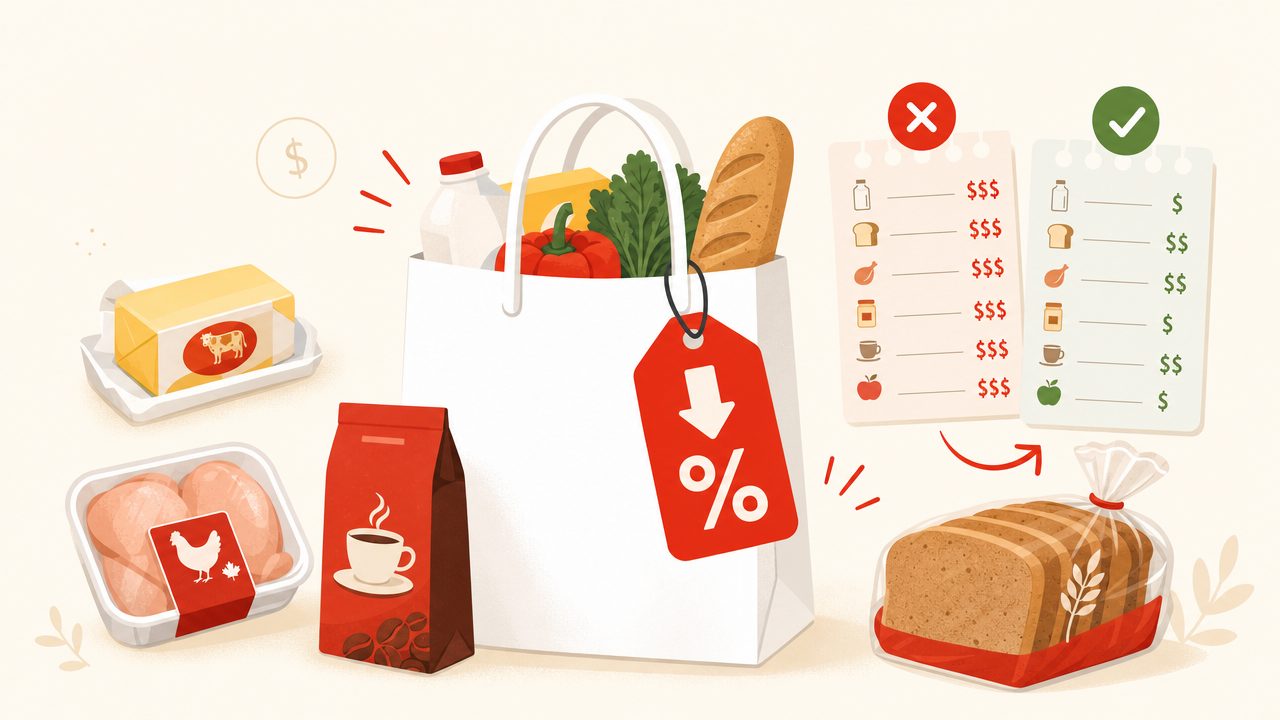
Grocery bills keep climbing, and every week feels more expensive. But a big chunk of the savings doesn't require extreme couponing or complicated apps — it just takes knowing how to read a flyer, compare the real prices, and plan around the deals.
Here's how it works, based on real Quebec flyer data.
1. Your store's flyer isn't always the best price
Every week, the big chains publish their flyers: IGA, Maxi, Metro, Provigo, Super C, Walmart and more. The natural reflex is to open your usual store's flyer and trust it.
That's a mistake.
The same product can be on sale at two competitors the same week — at different prices. Chicken, butter, coffee and staples rotate their best price from week to week and chain to chain. If you only compare your own store's flyer, you're overpaying without knowing it.
👉 The one habit that changes everything: compare this week's deals across grocery stores before making your list.
2. Compare the unit price, not the shelf price
A 500 g box at $4.99 looks cheaper than a 750 g box at $6.49. But per unit, it's the opposite: the big box works out to $8.65/kg, the small one to $9.98/kg.
Flyers often show both — but not always. When the unit price (the "$/kg" or "$/L") is missing, divide the price by the quantity. That's the only calculation that matters when comparing two sizes.
Our tool shows the unit price on every product for exactly that reason.
3. Watch out for shrinkflation
Sometimes the price doesn't change — but the package shrinks. That's shrinkflation: a 450 g bag becoming 410 g at the same price is still a price hike, just better hidden.
In Quebec, package-size changes are tracked week after week. Before buying a product "at the same price as before," check that the size hasn't quietly shrunk.
👉 See the shrinkflation tracker for Quebec
4. Plan your meals around the sales
The big savings don't come from buying less — they come from buying what's on sale, at the right time. If ground beef is on special this week, it's meatball week, not full-price chicken week.
Planning in reverse (deals first, meals second) works because protein is the biggest slice of the grocery bill. On-sale produce does the rest.
👉 Generate meal ideas from this week's real deals — recipes priced at your actual store.
5. Know each store's rhythm
Every chain has a lane:
- Maxi and Super C: everyday low prices plus aggressive specials. Great starting point.
- IGA and Metro: pricier at regular price, but good specials on house brands and meat.
- Provigo: solid specials, often stacked with PC Optimum points.
- Walmart: steady low prices, modest flyer.
- Independent and specialty grocers (Adonis, Kim Phat, Marché Newon…): unbeatable prices on ethnic staples, seafood and Asian produce.
Browse deals by store to see what each one is offering this week.
6. The golden rules, summarized
- Compare before you buy — never after.
- Always look at the unit price.
- Check the size: a "same price" deal can hide a smaller package.
- Buy what's on sale, not what catches your eye.
- Come back every week — the best prices rotate.
That's exactly what Circulaires Québec does: every Quebec grocery store's deals, compared side by side, every week. The real price, period.